The 3 to 5 Year Rule, and What Moves It
Most septic tanks in El Dorado County should be pumped every 3 to 5 years. That is the range that keeps solids out of your leach field, and the leach field is the part of the system you can least afford to replace. Where you fall inside that range depends on three things: how many people live in the house, how big the tank is, and what goes down the drains. A retired couple with a 1,500 gallon tank can often stretch toward 5 years or beyond. A family of five with a 1,000 gallon tank and a garbage disposal should be thinking 2 to 3.
The reason the interval exists at all is simple. The tank's job is to hold solids while liquid passes through to the leach lines. Solids build as sludge on the bottom and scum on top, and the space between them, where settling actually happens, shrinks every year. Once the solids take up about a third of the tank, they start riding out with the effluent into the leach field. Soil and gravel do not pass solids. They clog. And in the tight clay and decomposed granite soils common around Placerville, a leach field does not get a second chance once it plugs.
The Household Size Math
You can rough out your own interval with a simple relationship: tank size divided by the number of full-time occupants. A few common El Dorado County setups:
- 2 people, 1,000 gallon tank: pump about every 5 years
- 4 people, 1,000 gallon tank: pump about every 2 to 3 years
- 4 people, 1,500 gallon tank: pump about every 3 to 4 years
- 6 people, 1,500 gallon tank: pump about every 2 years
If you do not know your tank size, the county Environmental Management office keeps permit records for most systems, and the original permit usually lists the tank capacity and a site diagram. Older homesteads off Pleasant Valley Road or up in Kelsey sometimes predate good records, in which case the first pump-out doubles as a fact-finding visit: the contractor can measure the tank and tell you what you have.
Pumping, Emptying, Cleaning: Same Truck, Same Schedule
Homeowners ask how often to empty a septic tank, how often to clean one, and how often to pump one as if they were three different services. Around here they are the same visit. The truck vacuums out the liquid, breaks up and removes the sludge and scum, and hauls it all to a licensed disposal facility. Some companies say cleaning when they include rinsing down the tank walls, but no reputable local outfit charges for three separate rituals. Whatever word your invoice uses, the 3 to 5 year interval is the answer, and the price range is the same. The thing your tank does not need on any schedule is an additive that promises to replace pumping; bacteria arrive free with every flush, and nothing poured down a drain removes solids.
Garbage Disposals Change the Math
A garbage disposal is the single biggest schedule-shortener in the book. Ground food waste does not digest in the tank the way human waste does. It sinks, builds sludge fast, and can cut your interval by a third or more. If you run a disposal daily, treat a 4 year plan as a 3 year plan. Better yet, compost or trash the food scraps and keep the disposal for scraps you missed. The same logic applies to grease, coffee grounds, and "flushable" wipes, which are flushable in the same sense that a wallet is flushable.
Vacation Homes and Rentals: Apple Hill and Sly Park Patterns
El Dorado County has a lot of part-time houses, and they follow their own rules. A cabin near Sly Park that sits empty all week and hosts eight people every summer weekend puts shock loads on a system that spends most of its life dormant. The bacteria in the tank die back during empty stretches, then get buried in use before they recover. Short-term rentals around Apple Hill see the same pattern in reverse season: quiet summers, then slammed October weekends when the crowds come up for the farms.
For these properties, occupancy days matter more than calendar years. A rental that sleeps 8 and books 120 nights a year is working as hard as a full-time family home and should be pumped on the short end of the range, every 2 to 3 years. It is also worth having the tank inspected before each heavy season, because a failure during a booked October weekend becomes an emergency call with guests on site.
What Happens When You Skip a Cycle
Skipping a pump-out does not cause a problem you notice that year. That is what makes it tempting. What actually happens is quieter: the sludge blanket rises past the outlet baffle, fine solids start seeping into the leach lines, and the biological mat at the soil interface thickens. Drains slow a little. Then one wet February, when the clay soil is already saturated, the field cannot keep up and effluent surfaces in the yard or backs up into the house. A pump-out costs a few hundred dollars (see our septic pumping cost page for local ranges). Leach field repair runs into the thousands, and full leach field replacement with county Environmental Management permits, engineering, and excavation on a foothill lot can pass $20,000 to $40,000 (the system cost page breaks that bill into line items). That is the trade. Pump on schedule or replace early.
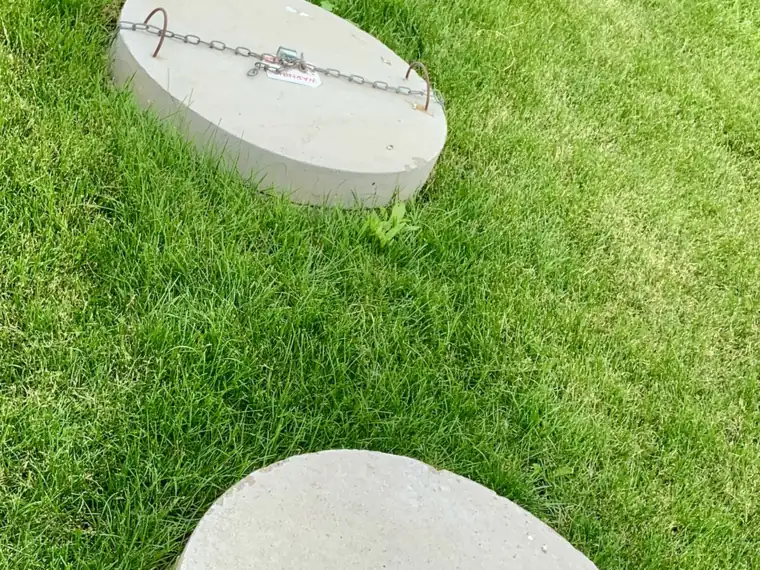
No Records? Here Is How to Tell If You Are Overdue
Plenty of people buy a foothill home and inherit a tank with no paperwork. Signs you are overdue:
- You have lived there 4 or more years and have never had it pumped
- Drains run slow throughout the house, or gurgle after laundry
- Odors near the tank lids or leach field, especially on warm evenings
- Unusually green or soggy ground over the tank or lines in dry months
- Any backup at the lowest drain in the house
The definitive answer takes one visit. A contractor opens the tank and measures the sludge and scum. If the combined layers take up a third of the depth, you pump now. If not, they can tell you roughly how long you have. Scheduling a pump-out with an inspection at the same visit is the cheapest information you will ever buy about your system.
Keep a Maintenance Log
Start a simple file: date of each pump-out, who did it, tank size, sludge levels they reported, and anything they flagged. Add a sketch of where the tank lids and leach field sit, because finding a buried lid under three feet of decomposed granite fill is billable time. The log pays off twice. It keeps your schedule honest, and when you sell, a documented maintenance history makes the point-of-sale inspection smoother and gives buyers one less thing to negotiate on. If your records are blank and you cannot remember your last pump-out, that is the sign. Call a licensed local contractor, get a measurement, and start the clock properly. The contractors we refer handle exactly this call every week in Placerville, Camino, Pollock Pines, and the rest of the county.