How septic systems fail in the foothills
After enough years working tanks and fields around Placerville, the failures sort themselves into a short list. Knowing which one you have is most of the battle, because the fixes range from a few hundred dollars to a full replacement field.
- Failed baffles. The inlet and outlet baffles keep floating scum and settled solids away from the pipes. On older concrete tanks the outlet baffle rots off first, and once it is gone, solids flow straight to the leach field with every heavy water day. This is the most common finding in the county and one of the cheapest to fix.
- Root intrusion. Oaks, pines, and cedars send roots to moisture, and a leach line is the most reliable moisture source on a dry summer hillside. Roots work into pipe joints, tank seams, and distribution boxes, first slowing flow, then blocking it, then breaking the pipe apart.
- Cracked concrete tanks. Decades of soil movement, vehicle traffic over the tank, or plain age crack concrete. A cracked tank leaks in both directions: effluent out into soil where it should not be, and groundwater in during wet months, which is why a cracked tank reads full again weeks after pumping.
- Crushed or settled lines. The pipe run between house and tank, or tank and field, gets crushed by a truck, separated by settling fill, or bellied so it holds standing waste.
- Exhausted leach fields. The big one. Every field builds a biological mat in the soil over its working life, and after 25 to 40 years the surrounding soil simply cannot pass water anymore. No pump-out fixes an exhausted field, because the failure is in the ground, not the tank.
Warning signs that call for a repair visit
- Every drain in the house is slow, not just one fixture
- Gurgling in tubs or toilets when the washing machine empties
- Sewage smell outside, strongest after winter storms or heavy laundry days
- A stripe of bright green, wet grass over the leach lines in July or August
- Standing water or gray film surfacing downhill of the field
- A tank that needs pumping again within months of the last service
- Backups that arrive with the first big storms of the season
One slow fixture is a plumbing clog. All of them at once is a septic problem, and it is worth a call before the next load of laundry. If sewage is already in the house, go straight to our emergency page.
Diagnose before quote: the only honest way to price this work
A contractor who quotes a leach field replacement over the phone is guessing with your money. The contractors we refer work the other way around: find the actual failure first, then price the actual fix. A proper diagnosis means opening the tank and checking the baffles and liquid level, probing the field for saturation, running water under load to watch where it backs up, and pulling the El Dorado County permit file to see what is actually in the ground. Half the time, the symptom that looked like a dead field turns out to be a root-bound line or a collapsed baffle, and the bill drops by a factor of twenty. The other half of the time the field really is done, and you get that answer with evidence instead of a sales pitch. Either result beats guessing. Our how it works page explains what happens when you call.
Repair or replace: how the decision actually gets made
Not every failing system needs a new field, and not every field can be saved. The honest decision tree looks like this. Baffles get replaced in an afternoon for hundreds, not thousands. Root-invaded lines can sometimes be cleared and repaired in sections if the pipe itself is sound; if roots have crushed and filled long runs, sectional repair becomes throwing money down a hole. A cracked tank can occasionally be sealed, but a badly compromised concrete tank gets replaced, and modern plastic or fresh concrete tanks are the cheap half of any replacement anyway. The leach field is the fork in the road: a field that is hydraulically exhausted, where the soil around every line has sealed with biomat, does not respond to any repair. Repeated pump-outs on a dead field are rent, not repair. When the evidence points that way, the leach field replacement page covers what the project involves and what can still be saved short of it. When a contractor shows you a saturated probe, a tank backing up from the field side, and a 35 year old permit record, replacement is not upselling. It is arithmetic.
A load test performed during a septic inspection is often what settles the question, especially when a sale is involved.
Permits: how repair work runs through El Dorado County
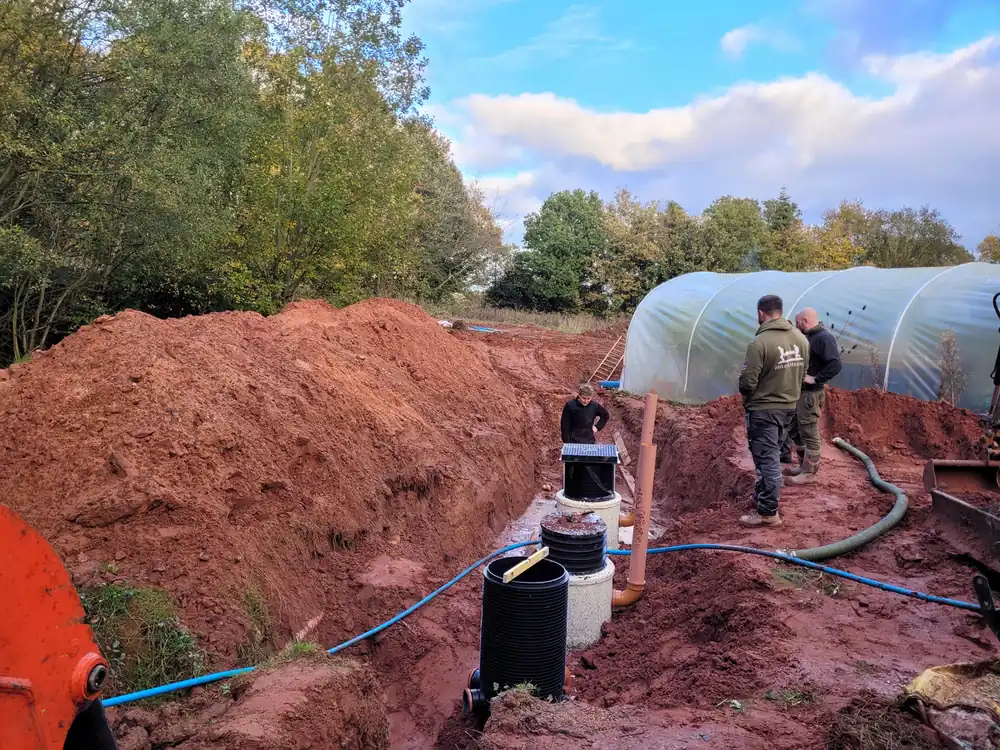
Pumping needs no permit. Almost everything else does. Tank replacements, leach field repairs, and field replacements all go through El Dorado County Environmental Management, and the process is real: an application with a site plan, soil evaluation or percolation testing to prove the ground can accept effluent, setback compliance from wells, property lines, and watercourses, and county inspection before anything is buried. Setbacks bite hardest on small parcels and anywhere near the river canyons around Coloma, and because most rural parcels here pair a well with the septic, the well setback frequently dictates where a new field can go. Licensed local contractors carry this process as part of the job; they know what the county reviewers want to see and how long approval actually takes. Unpermitted repair work is the false economy of the foothills: it saves weeks now and surfaces at the next real estate transaction as the buyer's leverage.
Engineered systems for steep and rocky ground
Plenty of El Dorado County lots cannot take a conventional gravity field. Slopes too steep to trench safely, granite too shallow to dig, clay that will not percolate, or a parcel where setbacks leave no room. County code has answers for these sites, and they cost more: pressure-dosed distribution that pumps effluent uphill or meters it evenly across a slope, mound systems that build the treatment soil above grade, and other engineered designs specified by a qualified designer and approved by Environmental Management. This is exactly where local experience earns its fee. A contractor who has put systems into Garden Valley hillsides and Somerset ranch ground knows what the county will approve on your kind of site before the excavator ever shows up, and that knowledge prevents the most expensive mistake in this trade: building the wrong system twice.
What waiting costs
Septic failures do not heal, and they price like it. A missing baffle ignored for two years quietly loads the field with solids, converting a $600 repair into a shortened field life. A root-blocked line ignored until winter becomes a sewage backup during the first week of storms, when every contractor in the county is busy and the ground is too saturated to excavate cleanly. Field replacements on foothill lots run $15,000 to $40,000 with permits, engineering, and rock excavation (see the septic system cost guide for the full breakdown), and doing that work under emergency conditions in February costs more than doing it planned in September. The cheapest version of every repair is the earliest one.
After the repair: protect the fix
A repaired system goes back on the standard schedule: pump every 3 to 5 years, keep water use steady rather than in bursts, and keep vehicles and new tree plantings off the field. Keep the permit sign-off and invoices with your pumping records, because that paperwork is worth money at sale time. Our pumping page covers the maintenance rhythm, and the FAQ answers the questions repairs usually raise.
Repair questions foothill owners ask
Can a failing leach field be rested back to health?
Sometimes, partially. Cutting water use hard, fixing the solids source, and giving a stressed field months of light duty can recover some capacity. A truly exhausted field, sealed with decades of biomat, does not come back. A load test tells you which you have.
Do repairs require re-doing the whole system to current code?
Usually not. The county permits the repair in front of it; a baffle or line repair does not force a full system upgrade. A field replacement is designed to current standards because it is new construction in the ground.
How long does a permitted leach field replacement take?
Design and county approval commonly take a few weeks, and the excavation itself a few days once approved. Wet winter ground can push scheduling, which is one more reason to act on warning signs in the dry months.
Is trenchless or jetting repair an option for root damage?
Jetting clears roots from lines that are still structurally sound and buys time, especially paired with cutting back the offending trees. Once roots have broken the pipe, cleared lines refill, and section replacement is the durable fix.