What counts as a septic emergency
Some septic problems can wait for a convenient appointment. These cannot:
- Sewage backing up into tubs, showers, or floor drains, which are the lowest openings in the house and always the first to show it
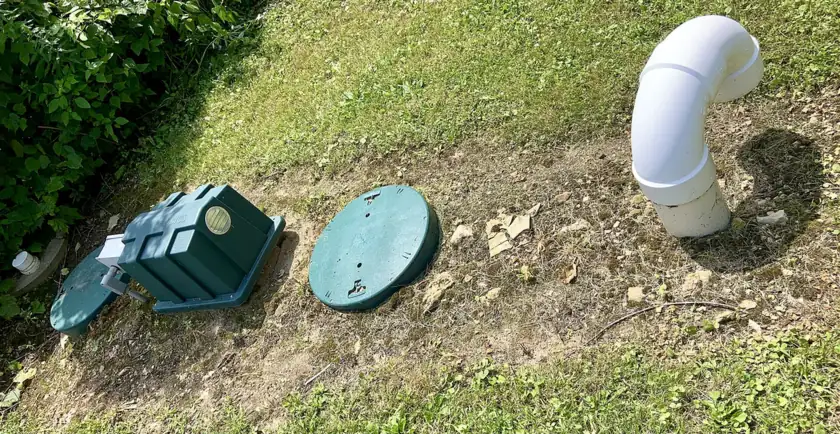
- Waste surfacing at the tank lids or pooling in the yard
- Effluent running downhill toward a well, a creek, a pond, or a neighbor's property
- A total loss of drains: nothing in the house will empty, and every flush rises somewhere
- A backup in a house full of people, whether that is your family, holiday guests, or a booked short-term rental near Apple Hill
- An alarm sounding on a pumped or engineered system, which means the dose tank is filling with nowhere to send it
The common thread is that the situation gets worse with every gallon. Raw wastewater is a genuine health hazard, and a system that has stopped accepting water has no slack left. Slow drains that still drain, or a smell with no surfacing sewage, are urgent but not emergencies; those belong on the repair page and can usually book a next-day visit.
What to do right now, before the truck arrives
The next thirty minutes matter more than most homeowners realize. Here is the order of operations:
- Stop sending water down the drains. Every flush, every dish rinse, every laundry cycle adds to a system that has nowhere to put it. Shut the washing machine off mid-cycle if you have to. The backup cannot rise further if nothing feeds it.
- Do not open the tank. This one is not negotiable. Septic tanks produce hydrogen sulfide and methane, gases that can drop a healthy adult in seconds inside the tank opening, and concrete lids weigh more than they look. People die in this country every year going into septic tanks to help. Leave the lids to the crew.
- Keep people and pets away from any surfacing sewage, indoors or out. Close off the affected bathroom. Move kids and dogs off the wet part of the yard.
- Do not run to the hardware store. No drain chemical fixes a full septic system, and caustic products in the standing water make the cleanup more hazardous for everyone.
- Note the useful facts. When did it start, what were you running at the time, where is the tank, when was it last pumped. Sixty seconds of answers helps the dispatcher send the right response. See how the referral call works.
How an emergency pump-out buys you time
In almost every backup scenario, the first move is the same: get a vacuum truck on the tank and empty it. Pumping the tank drops the liquid level below the house line, and the backup in your tubs and drains recedes within minutes. It works whether the underlying cause is a saturated leach field, a root-blocked line, or a tank that has quietly filled with solids, because all of those failures share one symptom: a tank with no room. A full pump-out gives the household roughly a tank's worth of breathing space, several days of careful, reduced water use for a typical family, which is enough time to diagnose the real problem and fix it in daylight at normal rates instead of at midnight. What a pump-out does not do is cure anything. If the field is saturated or dead, the tank refills and the clock restarts. Treat the emergency visit as the tourniquet, not the surgery.
Local trucks against the map: response time in this county
El Dorado County covers a lot of ground and most of it is up a grade. That geography decides response times. A crew dispatched from Sacramento fights an hour of Highway 50 before it even reaches the county line, and that is on a clear summer day. A Placerville-based truck is a different story: minutes to Diamond Springs, a short run to Shingle Springs or Camino, twenty-five minutes up the hill to Pollock Pines. The operators we refer are the ones already working these roads every day, which also means they know the practical details that shave time off an emergency: which narrow roads a loaded truck can actually turn around on, how to stage on a steep gravel driveway in Garden Valley, and how far a hose has to run when the tank sits below the house. When there is sewage in your hallway, that local knowledge is the difference between a bad afternoon and a bad weekend.
Winter storms: when emergencies cluster
Septic emergencies in this county are seasonal, and the season is winter. Weeks of rain saturate the decomposed granite and clay soils that most local leach fields sit in, and a field that ran fine all summer suddenly cannot pass water. Marginal systems fail in clusters during the first big atmospheric river of the year, which means trucks are busiest exactly when the driving is worst. Snow at the Camino and Pollock Pines elevations adds chain controls and closed back roads; runoff turns long gravel driveways soft enough to bog a loaded truck. Two practical takeaways. First, if your system struggles every winter, get it inspected and fixed in the dry months, because our inspection page is cheaper reading in September than in January. Second, when you call during a storm, be straight about your access: grade, surface, snow, and where the tank sits. A crew that knows what it is driving into gets to you faster and safer.
What emergency service costs
Expect an emergency or after-hours pump-out to run meaningfully above the routine $400 to $700 range, with night, weekend, and holiday calls at the top of the spread, plus more if lids have to be dug out by flashlight. It is worth every dollar measured against sewage standing in a hallway, but the arithmetic is also the argument for maintenance: a routine pump-out on schedule costs half of what the same truck costs at 2 a.m. The pumping cost guide breaks down both numbers.
After the emergency: get the diagnosis while the truck is there
The most expensive mistake in an emergency is treating the pump-out as the end of the story. Before the truck leaves, ask the operator what they saw: was the tank overloaded with solids, was liquid running back into the tank from the field side, were the baffles intact, was groundwater leaking in. Those observations, made while the tank is open and empty, are free diagnosis. If the field was the problem, saturated ground will send the backup right back in weeks, and you want that conversation started now, not at the next overflow. A backup caused by simple neglect resets with pumping and a schedule. A backup caused by a failing field or broken component is the system telling you what it needs; the repair and leach field page covers what comes next, and routine pumping keeps you off this page entirely.
Emergency questions, answered fast
How fast can a truck actually get here?
Same-day is realistic across most of the county, and backups with sewage in the house get priority. Response depends on where trucks are working and, in winter, what the roads are doing. Call, describe the situation plainly, and you will get an honest window, not a promise invented to win the call.
Should I shut off my water at the main?
You do not need to shut the main; you need to stop using drains. Water you do not send down a pipe cannot back up. Shutting the main is a reasonable belt-and-suspenders step in a house full of guests who will not stop flushing.
Is a sewage backup covered by homeowners insurance?
Standard policies often exclude it unless you carry a specific sewage or water backup endorsement. Check your policy, photograph everything before cleanup, and keep the pump-out invoice either way.
The toilets gurgle but nothing has backed up yet. Emergency?
Not yet, and that is exactly the moment to act. Gurgling means air is fighting through a system that is nearly full or nearly blocked. Cut water use today and book a service visit now, while it is still a scheduled appointment instead of an emergency.