How much does it cost to install a septic system?
In El Dorado County, a conventional gravity septic system, meaning a tank plus a trenched leach field on ground that percolates, typically costs $15,000 to $40,000 installed. That range covers the site evaluation, county permits, the tank itself, excavation, leach field materials, and final inspection. Lots that cannot take a conventional field need pressure-dosed or mound systems, and those regularly land between $30,000 and $60,000, occasionally beyond it on the steepest and rockiest parcels. National averages you find online run far lower, and they are not wrong for flat lots in soft midwestern soil. They are wrong for here. Foothill ground writes its own invoice.
Replacement of a failed system costs about the same as new construction, and sometimes more, because the new field must go in undisturbed soil away from the old one while keeping every setback from your well, your property lines, and any seasonal drainage. On a small parcel that puzzle can be the hardest part of the whole job.
The line items behind the number
A septic installation bill in this county is really six or seven smaller bills. Knowing them makes any quote easy to read.
- Site evaluation and percolation testing: roughly $1,000 to $3,000. Before anything is approved, the soil has to prove it can accept effluent. A qualified professional digs test pits or perc holes, logs the soil profile, and documents seasonal groundwater. On ground with shallow granite or heavy clay, expect more test locations and more cost.
- Design and engineering: roughly $1,500 to $5,000. Conventional systems on friendly ground need a simple design. Slopes, poor soils, and tight setbacks push the job to an engineered design, and the fee follows the difficulty.
- County permits and review. Tank and field work runs through El Dorado County Environmental Management: application, plan review, and inspections before backfill. Budget in the range of a thousand dollars or more once review fees are counted, and confirm current fees with the county, because they change.
- The tank: roughly $1,500 to $4,000 set in place. A 1,000 to 1,500 gallon concrete or poly tank is the cheap half of any system. Risers and an effluent filter belong in this line and are worth every dollar.
- The leach field: usually the biggest line. Trenching, drain rock or chambers, distribution piping, and backfill commonly run $8,000 to $25,000 depending on the required field size, which the perc results dictate, and on how hard the ground digs.
- Excavation extras. Rock hammering through decomposed granite, hauling spoils off a tight site, tree removal, and long equipment access all show up in foothill quotes because they all show up in the workday.
- A pump, where gravity will not do: roughly $1,500 to $4,000 more. Homes below their field need an effluent pump, a pump basin, and an alarm. Replacing a worn pump later typically runs $800 to $2,500, which is worth knowing before you buy a pumped system on a bid that a gravity design could have avoided.
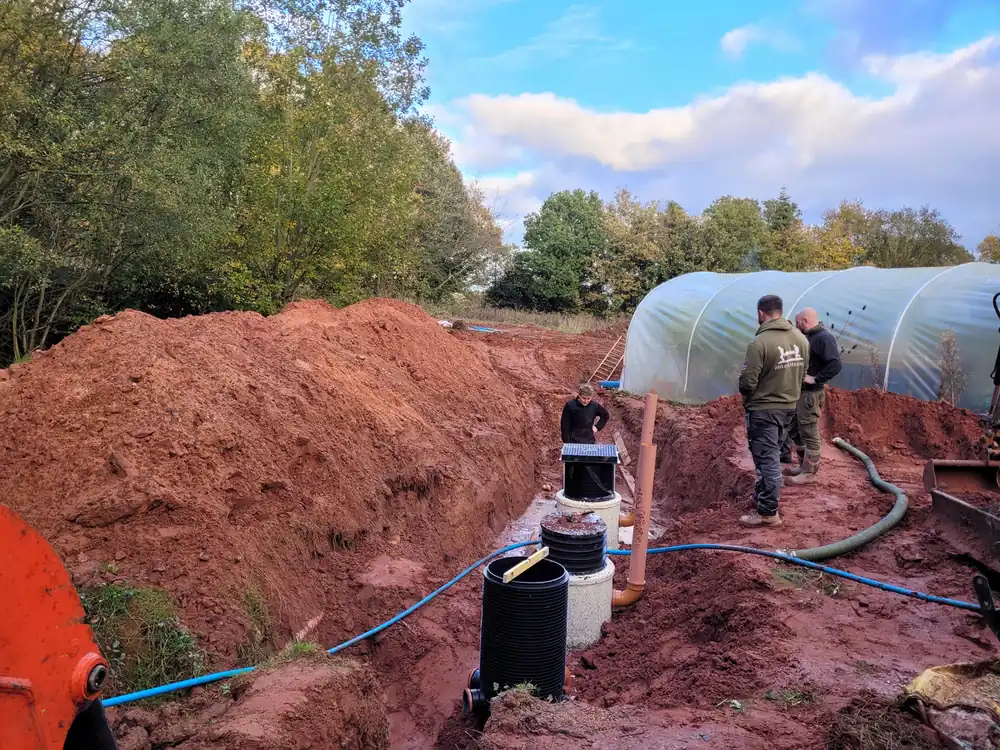
Why El Dorado County jobs cost more than the averages
Four local facts drive most of the spread between a $15,000 job and a $40,000 one. First, soil: decomposed granite percs unpredictably and clay layers hold water, so fields here often need more lineal feet of trench than the same house would need elsewhere. Second, slope: much of the county between Shingle Springs and Pollock Pines simply is not flat, and steep ground means benched trenches, pressure dosing, or a mound. Third, setbacks: most rural parcels pair the septic with a private well, and the required separation frequently dictates the field location rather than convenience or cost. Fourth, access: getting an excavator, a tank truck, and material deliveries to the back of a wooded parcel above Garden Valley takes time that flat subdivision lots never bill for.
Septic repair costs, from small to serious
Not every problem is a new system, and the repair menu is worth knowing before anyone talks replacement. Honest local ranges:
- Replacing a failed inlet or outlet baffle: a few hundred dollars
- Repairing or replacing a distribution box: $500 to $1,500
- Clearing and repairing a root-invaded or crushed line, per section: $1,000 to $5,000
- Sealing a repairable tank crack: $500 to $2,000
- Replacing an effluent pump: $800 to $2,500
- Replacing the tank alone, field still healthy: $5,000 to $12,000
- Leach field replacement: see the full range above, and the leach field replacement page for the whole process
The pattern is plain: everything above the field is thousands or less, and the field is tens of thousands. That is why the maintenance math on our pumping cost page favors the $400 to $700 pump-out every few years. It is the insurance premium on the big number.
Repair or replace: getting the call right
A system with a bad baffle or one crushed line does not need replacement, no matter what a hurried bid says. A field that is hydraulically dead does not need another repair, no matter how much cheaper that sounds this month. The difference is a diagnosis: opening the tank, probing the field, running water under load, and pulling the county permit file. Our septic repair page walks through how the contractors we refer make that call with evidence, and a load test during a septic inspection settles it when a home sale is on the line.
Cost questions homeowners ask
How long does an installation or replacement take?
Once the county approves the permit, the dirt work itself usually runs a few days to two weeks depending on ground and weather. The calendar time that surprises people is up front: soil testing, design, and county review commonly take several weeks. A failing system in November is a spring project unless it becomes an emergency first, which is the expensive way to schedule it.
Can I install or replace a septic system myself?
The county requires permitted work with proper soil evaluation, design, and inspections, and lenders and buyers will ask for that paper trail at sale time. Between the engineering, the excavation, and the inspection schedule, this is licensed contractor territory. Owner-built shortcuts tend to resurface as the most expensive line in a future escrow.
Will homeowners insurance cover a failed septic system?
Almost never for age and wear, which is how most systems fail. Policies sometimes respond to sudden damage from specific events, but a 30 year old field that finally sealed itself is a maintenance item in the insurer's eyes. Ask your agent, and plan as if the answer is no.
How should I budget if my system is old but still working?
Get a baseline: a pump-out with an honest look at the tank, baffles, and field. If the system is past 25 years, start setting aside for replacement while keeping the pumping schedule tight, because solids reaching an aging field is the one variable you fully control. When the numbers come from a measured tank and a probed field instead of a guess, budgeting stops being scary and becomes arithmetic.
For a real number for your parcel, call the phone number at the top of this page. A licensed local contractor will look at your ground, your access, and your county file, and quote the system your site actually needs, whether you are in Rescue, Shingle Springs, or up the hill in Pollock Pines.